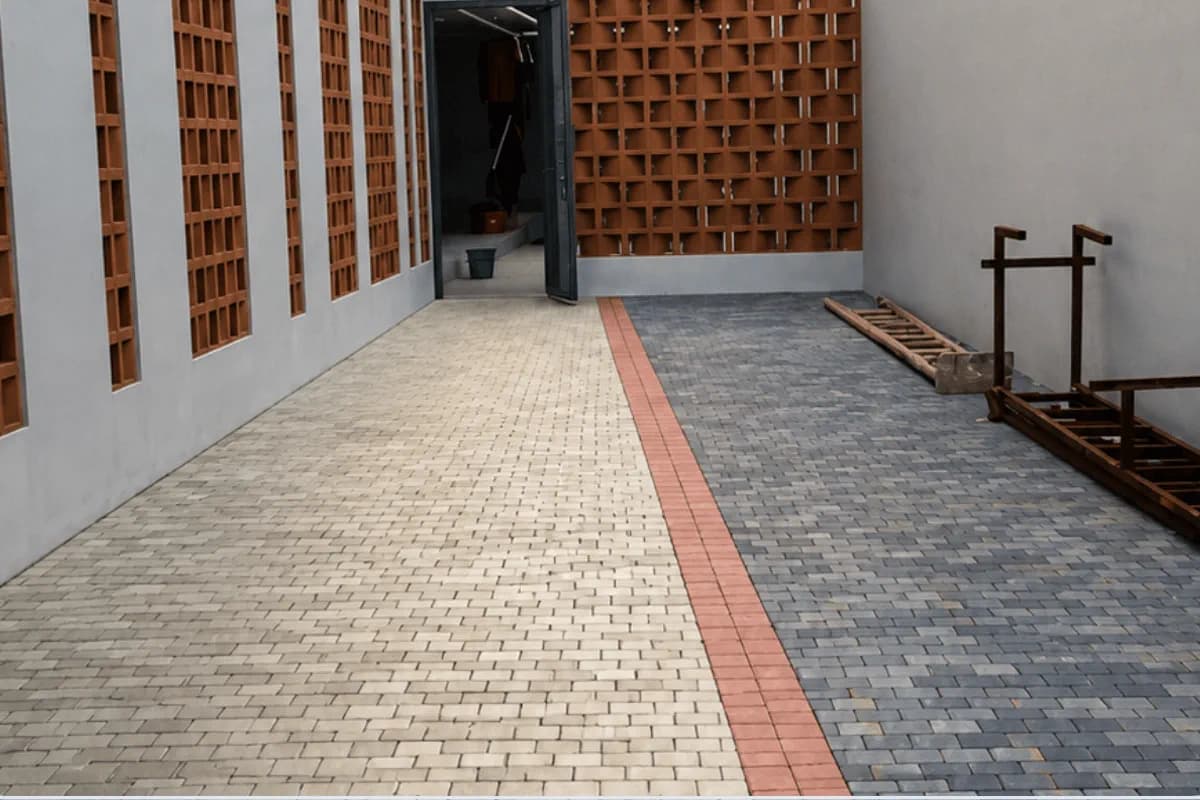
Paving Block / Conblock Prices in Greater Jakarta 2026
A comprehensive budget guide and pricing methodology for concrete paving blocks across Greater Jakarta in 2026, comparing material grades, scope choices, and quotation parameters.
7 min read
Published: October 2, 2026
•Updated: October 3, 2026
K
Kaha Block Technical Team
PT Kaha Sukses Mandiri • Cisauk, Tangerang
Table of Contents
Paving block prices starting from Rp80,000/m²* for material procurement across Greater Jakarta (*final pricing may vary based on specifications, order volume, project location, and service requirements). This initial figure provides a commercial baseline for early budget planning rather than a uniform price across every project scenario.
When preparing a bill of quantities (BoQ) for outdoor pavements, modular concrete blocks require a structured calculation. The final project proposal depends on concrete compressive strength ratings, block thickness, net square meters, and whether site works require material supply only or a turnkey civil installation package.
This master regional guide outlines how quotations are structured across Jakarta, Bogor, Depok, Tangerang, and Bekasi, what technical variables drive cost adjustments, and how project owners can systematically evaluate supplier proposals.
1. Understanding the Starting Baseline of Rp80,000/m²*
The baseline Paving block prices starting from Rp80,000/m²* represents standard precast units at factory gate for standard production batches. It does not include perimeter curb restraints, long-distance freight to restricted access zones, or specialized installation labor.
Using a starting figure as an all-inclusive estimate can distort civil budgeting. A pedestrian pathway carrying foot traffic requires substantially different technical parameters than a warehouse apron supporting heavy commercial trucks.
Product Specifications & Profiles
Review shapes, dimensions, and compressive grades directly through our product catalog prior to requesting an official project proposal.
2. Technical Variables Determining Official Quotations
When manufacturers formulate a formal project proposal, several primary technical parameters shape the final cost per square meter:
Key Cost Factors:
Total Area Coverage (m²): Overall square meter volume dictates production batch efficiency and transport fleet utilization.
Block Thickness Selection: Choosing between 6 cm, 8 cm, or 10 cm units determines the raw material volume of cement and aggregates compacted during hydraulic pressing.
Concrete Compressive Strength: Grades K-250, K-300, and K-400 are formulated to support designated wheel axle load capacities.
Unit Geometry and Model: Rectangular Truepave units feature different laying speeds compared to interlocking Hexagonal or Tile patterns.
Perimeter Edge Restraints: Kanstein curb units are essential along pavement edges to prevent horizontal shifting under traffic loads.
3. Scope Decision: Material Supply vs Turnkey Installation
A critical budget step is establishing the contractual scope required for your site:
Material Supply Only: The plant manufactures and delivers palletized paving units to the designated drop-off point. Subgrade earthworks, bedding sand leveling, and plate compaction are managed independently by the client's site contractor.
Turnkey Supply & Installation: A specialized paving crew executes bedding sand preparation, interlocking pattern laying, joint sand brushing, and mechanical plate compaction. Details regarding installation stages can be reviewed on our paving block installation service page.
4. Information Checklist Before Requesting a Quotation
To help our sales engineering team issue an accurate, transparent proposal, prepare the following project data:
Project Preparation Checklist:
Estimated net pavement area in square meters (m²), including an extra 3–5% allowance for edge cuts.
Specific site location (subdistrict and city/regency within Greater Jakarta).
Anticipated vehicular traffic (passenger cars, light commercial vans, or heavy freight trucks).
Site entry road access (access width and unloading staging area).
Scope requirement (material supply only or complete installed package).
5. Common Pitfalls When Comparing Supplier Proposals
Evaluating competing quotations based solely on headline price per square meter frequently leads to oversights. Common mistakes include ignoring concrete compressive strength ratings, omitting edge containment curbs, and incorrectly assuming that base material pricing includes site installation.
A reliable proposal clearly itemizes product specifications, dimensional tolerances, offloading arrangements, and contractual scope boundaries.
Greater Jakarta Pricing Key Points
The starting price of Rp80,000/m²* serves as a factory-gate baseline prior to order volume and specification adjustments.
Concrete strength grades (K-250 to K-400) and thickness (6, 8, 10 cm) are selected to correspond with planned vehicular axle weights.
Accurate proposals require clear square meter measurements, site location in Greater Jakarta, and scope definition.
Thorough evaluation must assess product compressive ratings, curb restraints, and site offloading logistics.
Frequently Asked Questions on Greater Jakarta Paving Prices
Q:Why does an official proposal differ from the baseline of Rp80,000/m²*?
The starting price of Rp80,000/m²* is a commercial baseline for standard factory materials. A formal quotation is customized based on exact surface area, selected concrete strength (K-250/K-300/K-400), block thickness, freight destination across Greater Jakarta, and installation requirements.
Q:Does the starting square meter price include site installation?
No. The baseline price covers precast paving block materials only. Installation services are quoted separately based on subgrade conditions, bedding sand volume, and site geometry.
Q:What details should be prepared before requesting an official quote?
Prepare the estimated surface area in square meters, specific site location within Greater Jakarta, anticipated vehicle traffic types, and your preferred scope (material-only or installed package).
Q:How do I determine whether my project needs 6 cm, 8 cm, or 10 cm thickness?
A thickness of 6 cm is suitable for pedestrian pathways and residential carports, 8 cm is standard for residential cluster roads and commercial parking areas, and 10 cm is commonly evaluated for heavy industrial logistics corridors.
A comprehensive guide to selecting paving blocks based on area application, traffic tonnage, block thickness, interlocking shapes, and proper laying patterns for homes and commercial developments.
An in-depth technical analysis comparing load capacities, vehicular tonnage tolerance, and application guidelines for 6 cm, 8 cm, and 10 cm concrete paving blocks.
A practical budget planning and quotation preparation guide for paving block projects across DKI Jakarta in 2026, addressing urban access, staging, and site measurements.